Implant-supported dentures use two or more dental implants to anchor a denture firmly to your jawbone, and most healthy adults missing all or most of their teeth in one arch are good candidates. The full process usually takes six to nine months from your first consultation to your final denture. Your cost depends on how many implants you need, whether you need bone grafting first, and whether we treat one arch or both.
In short: implant-supported dentures stay put when you eat, talk, and laugh, with no adhesive. They also help protect your jawbone, cost more upfront than traditional dentures, and often save you money on relines and replacements over time. Below, we walk through how they work, what the process looks like at our Newberry office, what affects the price, and how to tell whether they fit your needs.
What Exactly Are Implant-Supported Dentures?
You may also hear them called snap-in dentures or overdentures. We place small titanium implants in your jawbone, where they act like artificial tooth roots. Once those implants heal, we fit your denture with matching connectors so it clicks securely onto them.
You can still remove the denture to clean it, but it won’t slip, rock, or rely on paste or suction to stay in place. That one change makes a big difference for people who have struggled with loose dentures for years.
How Do Implant-Supported Dentures Compare to Traditional Dentures?
Traditional dentures sit on top of your gums. Over time, your jawbone shrinks without tooth roots to stimulate it, so the fit loosens and the denture needs relining or replacing. Implant-supported dentures change that equation in several ways:
- They stay stable. Your denture won’t shift while you eat or speak.
- They help preserve bone. Implants stimulate your jawbone, which slows the bone loss that changes how dentures fit.
- They let you eat more of what you love. Most patients chew much better and enjoy a broader diet, though we still recommend skipping very hard or sticky foods.
- They can feel less bulky. An implant-supported upper denture may cover less of your palate.
- They last. We design implants to last permanently, and the denture itself typically lasts 10 to 20 years.
How Does the Implant-Supported Denture Process Work?
We handle every step in our own office, so you won’t bounce between specialists. Here’s what to expect:
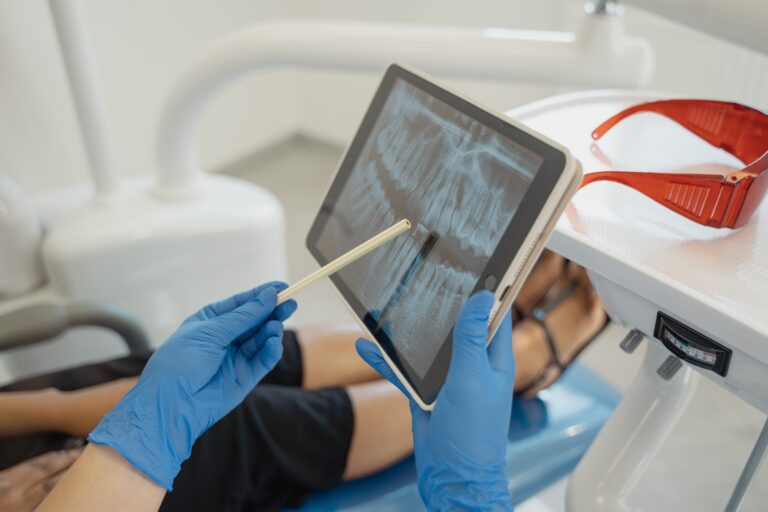
- Consultation and 3D CT scan. We review your medical history, examine your mouth, and take 3D images to measure your bone and plan exactly where each implant will go. If you need bone grafting, we plan it now.
- Implant placement. Dr. Williams places two or more titanium implants under local anesthetic. If you feel anxious, we offer oral conscious sedation. You’ll typically wear a temporary denture while you heal.
- Healing. Over about three to six months, your implants fuse with your jawbone, a process called osseointegration. We check in periodically.
- Attachment and fitting. We place attachments on your implants, fit your denture with matching connectors, and fine-tune the fit and bite.
- Follow-up care. We see you for routine check-ups and adjustments, and we replace the attachments as they wear.
Most patients go from first visit to final denture in six to nine months. Bone grafting adds time, and we give you a realistic timeline at your consultation.
How Much Do Implant-Supported Dentures Cost?
The cost of implant-supported dentures varies from patient to patient because every mouth is different. Three main factors drive the price:
- The number of implants. Most cases need at least two implants per arch, and upper arches often need four.
- Bone grafting. If your scan shows you need more bone, grafting adds to the total.
- One arch or two. Treating both upper and lower arches costs more than treating one.
Implant-supported dentures cost more upfront than conventional dentures, but many patients spend less over the long run because they avoid frequent relines, replacements, and adhesive. Many dental insurance plans cover the denture portion but not the implants. Our team verifies your benefits before your appointment, gives you a complete, itemized estimate before you schedule, and offers financing so you can spread out payments.
Who’s a Good Candidate for Implant-Supported Dentures?
You may be a strong candidate if you:
- Are missing all or most of your teeth in your upper or lower arch
- Have enough jawbone for implants, or can have bone grafting to rebuild it
- Don’t have active, uncontrolled gum disease
- Are healthy enough for minor oral surgery
- Feel comfortable with a treatment timeline of several months
People who feel frustrated with their current dentures often make excellent candidates, and so do people planning ahead before they lose their remaining teeth. Age alone doesn’t rule you out; your overall health and bone quality matter far more. Conditions like uncontrolled diabetes or heavy smoking can slow healing, so we may help you address those first.
Should You Choose Snap-in Dentures or All-on-4?
Both options use implants, but they work differently. Snap-in dentures are removable and click onto two or more implants. All-on-4 uses a fixed set of teeth that Dr. Williams secures to four implants, and you brush it like natural teeth. Dr. Williams recommends one or the other based on your anatomy, goals, budget, and personal preference, and he’ll also tell you if a bridge, crowns, or traditional dentures would serve you better.
How Do You Care for Implant-Supported Dentures?
Care stays simple. Take your denture out each night, clean it with a soft denture brush, and soak it overnight. Gently clean the attachments and the gum tissue under your denture, and use a soft brush and a water flosser around the implant attachment points. Keep up with regular check-ups so we can catch wear early.
Why Do Newberry Patients Trust Radiant Dentistry with Implant-Supported Dentures?
Dr. Sean Williams, a native Floridian, earned his Doctorate in Dental Medicine from the University of Florida College of Dentistry and then completed a post-doctoral fellowship in Dental Implant Surgery and Prosthetics. He also holds a Fellowship in the International Congress of Oral Implantologists (FICOI), a credential held by fewer than 10% of general dentists in the country.
That training means Dr. Williams reads your CT scans himself, performs your implant surgery and any bone grafting, and delivers your final denture, all under one roof with no outside referrals. Our office uses 3D CT-guided implant planning, Medit digital scanners, digital X-rays, intraoral cameras, and platelet-rich fibrin (PRF) to support healing. We also offer nitrous oxide and oral conscious sedation for patients who feel nervous about dental care.
We proudly serve patients from Newberry, Gainesville, Alachua, High Springs, Archer, Bronson, Micanopy, Williston, and nearby communities.
FAQ: Implant-Supported Dentures
How long do implant-supported dentures last?
The implants are designed to last permanently, and the denture typically lasts 10 to 20 years. We replace the small attachments as they wear, which keeps your denture snapping in securely.
How many implants do I need?
You need at least two implants per arch for a basic snap-in denture. We often recommend four for the upper arch because upper bone tends to be less dense and upper dentures get less reliable suction. Your 3D scan determines the final number.
Does getting dental implants hurt?
Most patients feel pressure rather than pain because we use local anesthetic, and sedation is available. Expect some soreness for a few days afterward, which medication manages well. Most people return to normal activities within about a week.
What if I’ve already lost jawbone?
Bone loss doesn’t automatically disqualify you. Dr. Williams performs bone grafting in-house to rebuild the area before placing implants, though grafting does lengthen your overall timeline.
Am I too old for implant-supported dentures?
No. Implants have no upper age limit. Your general health and bone quality matter much more than your age.
Does insurance cover implant-supported dentures?
Many plans cover the denture but not the implants. We verify your benefits before your visit, provide an itemized estimate, and offer financing for any remaining balance.
Ready to Find Out If Implant-Supported Dentures Are Right for You?
You don’t have to keep living with loose dentures or putting off a decision about failing teeth. Schedule a consultation with Dr. Williams at Radiant Dentistry, and we’ll take a 3D scan, talk through your goals and budget, and tell you honestly whether implant-supported dentures, All-on-4, or another restorative option is right for you.
Call us at 352-354-3601, email admin@radiantdentistrysmiles.com, or visit us at 13576 NW 2nd Lane, Suite 30, Newberry, FL 32669. We look forward to helping you eat, speak, and smile with confidence again.